In schools
Cooking classes with young people and families: how they are organized and kept safe
At a glance
- Hands on food learning
- Food literacy has context
- Kitchen safety needs attention
- Research has limits
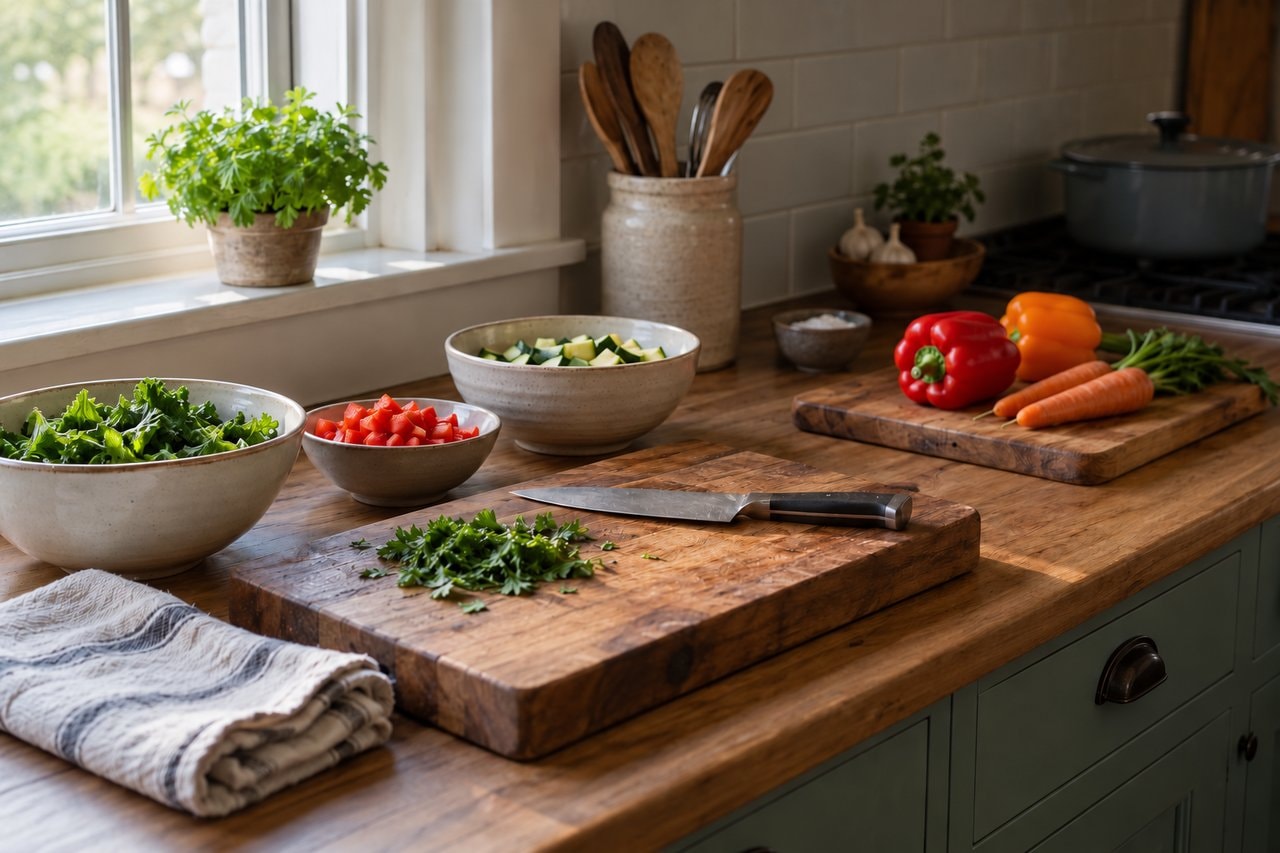
A cooking class is both a learning setting and a place where food is handled. For an adult organizer, those parts need separate attention. A lesson can concern preparation skills, confidence or food knowledge; the space also has surfaces, utensils, storage and food moving between tasks. This page explains how the research describes hands-on classes and how public safety sources describe food handling. It does not prescribe a menu or judge what a family eats.
Hands-on learning and food literacy
Wikipedia's food literacy article describes a concept that combines knowledge, skills and behavior concerning a person's relationship with food, and notes that definitions differ by setting. It also identifies social, economic, political, cultural and environmental influences. In a cooking class, that broad definition gives adult readers a way to distinguish a preparation task from the larger subject of food literacy. Familiarity with a kitchen technique is a skill; understanding food in its social setting reaches beyond that technique.
The distinction matters when describing a class's purpose. A program may discuss cooking confidence, practical preparation or food-related knowledge. Those are different subjects, and a description needs to say which one is being discussed. A single phrase such as food learning can hide those differences. The companion page on nutrition education in schools follows the teaching frameworks, while student-run produce stands describes another setting in which learning and food handling meet.
What reviews of classes examined
A 2014 systematic review in Preventing Chronic Disease examined hands-on childhood cooking programs and their associations with school-aged children's food preferences, attitudes and behaviors. Its authors considered preparation skills, reported intake, cooking confidence, preferences and food-related knowledge among the measured outcomes. They found variation in program duration, evaluation methods and outcomes. Their conclusion suggested possible positive influences, while emphasizing that widely differing measurements made best practices difficult to determine.
That is a finding about a group of studies, rather than a description of every school or community class. A measure of confidence does not answer the same question as a measure of food knowledge. A reported change during a program also leaves questions about what happens later. The review identified gaps concerning longer-term effects, program length and the usefulness of parent engagement, tasting lessons and other components. These are useful distinctions for reading an evaluation without turning it into a promise.
A 2024 systematic review in Appetite examined school-based cooking classes, vegetable intake, cooking skills and food literacy, using comparative studies and assessing risk of bias and evidence certainty. The authors reported small positive effects on cooking self-efficacy and vegetable intake, and called for consistent measurement of food literacy and cooking confidence in future interventions. Its school setting and comparison methods are part of the finding. It does not establish an ideal community class or tell an individual family what to eat.
Food handling belongs within the lesson
The FDA's Safe Food Handling page organizes its guidance around cleaning, separating, cooking and chilling. It describes washing hands and food-contact surfaces, keeping raw animal foods separate from other foods, checking cooking with a food thermometer and refrigerating perishables promptly. Those categories make the safety subject visible throughout preparation, rather than treating it as a final wipe of the counter. The agency's distinction between a food thermometer and appearance is especially clear: it says color and texture are unreliable indicators of safety.
For adults arranging a shared kitchen activity, the guidance connects tasks that can otherwise seem unrelated. Washing a cutting board concerns the surface that food will touch next. Separation concerns what has already touched a food or utensil. Cooking concerns temperature rather than how finished an item looks. Chilling concerns storage after preparation as well as food brought into the room. These are descriptions of the FDA's safety framework; the class's educational aims do not replace them.
Produce has its own handling questions
The FDA's Selecting and Serving Produce Safely page says to wash produce under running water, including produce grown at home, and advises against soap, detergent and commercial produce washes. It explains that washing may reduce bacteria but does not eliminate them, and that produce needs washing before peeling so material on the surface is not transferred during cutting. The same page describes separating raw produce from raw animal foods and their utensils, and cleaning food-contact equipment between these tasks.
This makes origin and handling distinct questions. Produce grown in a garden is still produce being prepared in a kitchen. A class focused on the garden can therefore discuss where food came from while retaining the FDA's handling steps. Its guidance also distinguishes produce labeled as prewashed and ready to eat from produce needing washing. A handling description needs that context rather than a blanket rule based only on appearance.
Young workers and the wider safety field
OSHA's Young Worker Safety in Restaurants eTool describes common hazards and potential safety solutions for teen workers and employers, with sections on cleanup, cooking, food preparation and serving. It also describes workers' rights. OSHA identifies eTools as advisory information that creates no new legal obligations. That scope is useful when considering a workplace resource alongside a teaching activity; it is not a complete rule book for every kitchen setting.
Wikipedia's food safety article describes food safety as a scientific field concerned with food handling, preparation and storage, and distinguishes biological, chemical and physical contamination. A class is only one setting within that larger field. The college volunteer handbook connects adult support roles with public safety sources, and youth jobs and leadership addresses work and learning as distinct responsibilities.
This is general information, not medical or dietary advice.