Neighborhood food
Community supported agriculture and produce-bag programs
At a glance
- CSA links growers and households
- Members share production risks
- Management and distribution arrangements vary
- Produce needs careful handling
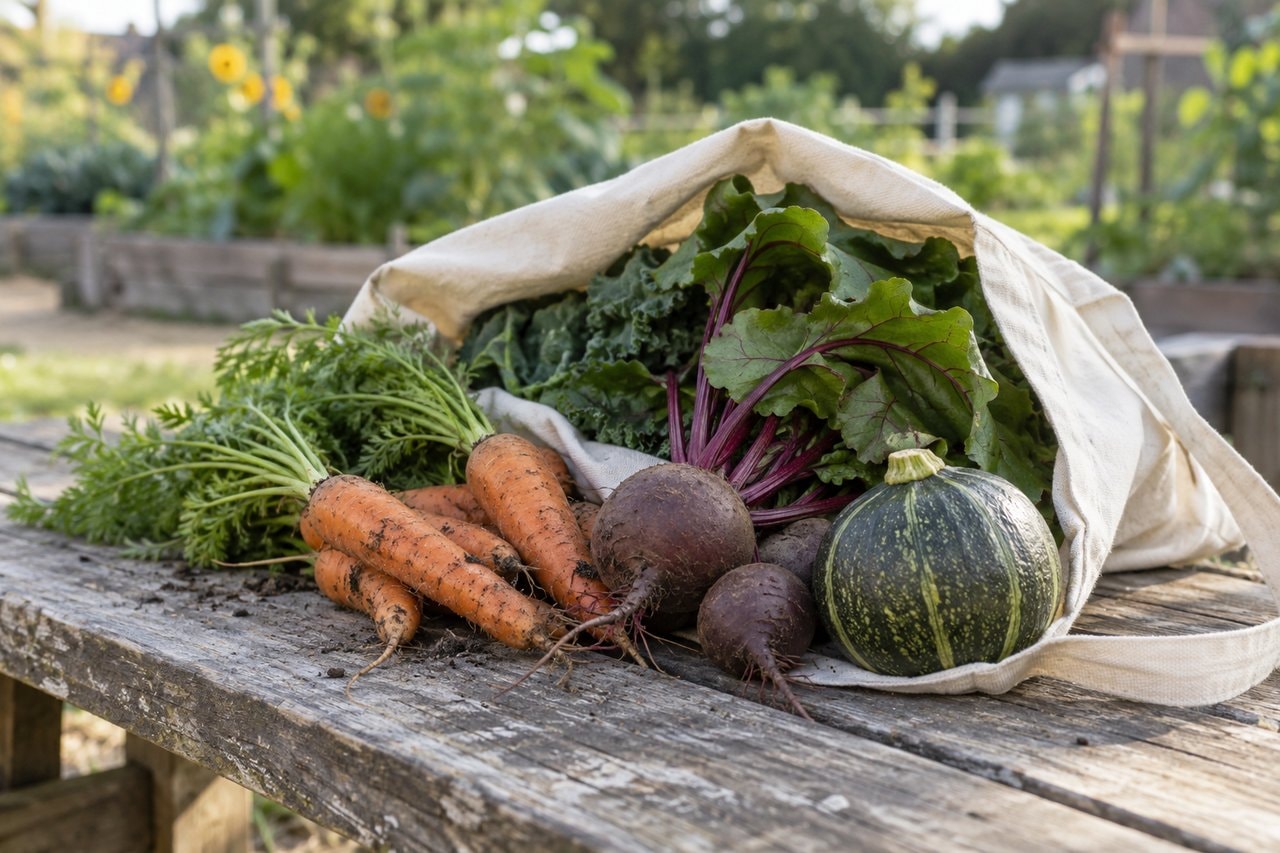
Community supported agriculture links a household to a harvest through an ongoing arrangement with a grower or group of growers. USDA's National Agricultural Library describes CSA as direct marketing in which growers and consumers support one another and share the risks and benefits of production. This is more than a description of vegetables placed in a container. The defining question concerns the relationship supporting production, including what participants commit and how the harvest is distributed.
Shares, subscriptions and shared risk
Wikipedia's community-supported agriculture article describes subscriptions to a farm's or group of farms' harvest. Members receive a recurring share of farm goods, while the producer and consumer share farming risks. It describes advance seasonal support as part of the model, with variations in how a budget is funded and how food is delivered. A share therefore names an arrangement around a harvest, rather than guaranteeing that every distribution has identical contents.
The timing of financial support and the handling of production risk help distinguish CSA from an ordinary separate purchase at a stand. They also distinguish the model from food distributed with no commitment to support the production budget. These are conceptual distinctions based on the references' definitions; they are not a judgment about which arrangement a household ought to use. Farmers' markets are considered separately because their defining feature is direct selling at a shared market location.
History and different forms of management
Wikipedia's CSA article places the use of the term in the northeastern United States in the 1980s and describes related approaches outside the country. Its history concerns a developing model of farming and distribution, rather than a single set of practices followed everywhere. The National Agricultural Library likewise presents historical information and research about changing CSA models alongside its definition. That combination of definition and variation is useful when reading a program description.
The encyclopedia distinguishes grower-managed arrangements, arrangements managed by members who hire a grower, farmer cooperatives and groups managed by growers and members together. The distinction concerns responsibility for decisions, rather than the shape of the produce container. The article also describes labor contributions as an alternative to part of a member's financial contribution. These variations show why the word CSA does not by itself settle who owns land, who handles distribution or how decisions about the farm are made.
Produce bags and access arrangements
Wikipedia's article describes CSA payment plans and options for households with low incomes, as well as distribution through farms, markets and community locations. Those options belong to the model's variations, rather than proving that every CSA has a subsidized share. A subsidized produce bag describes how some of the cost is supported; a school-garden-supplied bag describes the source of its crops. These labels identify different features. Neither label alone establishes the shared commitment and production-risk arrangement in the National Agricultural Library's definition.
For a produce-bag description, separating financing, growing and distribution is therefore useful. The bag is a way of moving produce. A school garden is a growing and teaching setting. A CSA is a producer-consumer arrangement. Growing, distribution and a CSA agreement are related subjects; a free produce bag does not by itself establish a CSA arrangement. The school gardens page explains growing as an educational setting, while the food access page considers availability and affordability.
USDA's Economic Research Service describes local foods as a research field that includes competing definitions and the characteristics of consumers and producers. Local does not resolve how a share is financed or what is included in it. It also does not supply a food-safety assessment or demonstrate a health outcome. Keeping the marketing category separate from those other questions gives each source's description its proper role.
Handling a share at home
The Food and Drug Administration's produce-handling guidance covers produce grown at home or obtained from stores and markets. It describes contamination during growing, storage and preparation. Its practical guidance calls for refrigerating perishable produce and produce purchased pre-cut or packaged. It also calls for keeping produce that will be eaten uncooked separate from raw animal foods and utensils used for them. These are attributed safety measures, rather than nutrition instructions or a meal plan.
The FDA describes washing produce under running water before preparation, including items whose skins will be removed. It advises against using soap, detergent or commercial produce wash. The agency explains that washing may reduce bacteria while leaving some present. A recurring distribution arrangement does not alter those handling distinctions. Cooking classes and kitchen safety discusses the preparation setting in greater detail without giving recipes.
What the narrative review found
A 2017 narrative review in the Journal of the Academy of Nutrition and Dietetics examined CSA participation as a dietary and health strategy. The authors reported that members often described greater fruit and vegetable consumption and variety, and changes in household food patterns. They also described generally high satisfaction alongside substantial membership turnover. Reports of participant experience and reports of health-related outcomes are different parts of the literature.
The review characterized dietary and health research as limited and largely descriptive. It found little experimental research and mixed experimental results, and identified problems involving survey tools, self-reporting and generalizability. It called for longitudinal study of repeated participation and the persistence of reported changes. These limits mean the findings are reported as research observations, rather than a promise about a CSA share, a produce bag or the result of participation for any household.