Neighborhood food
Farmers' markets, youth markets and food benefits at the market
At a glance
- Markets connect growers and customers
- Benefit arrangements differ by program
- Incentives are distinct from benefits
- Market outcomes need evaluation
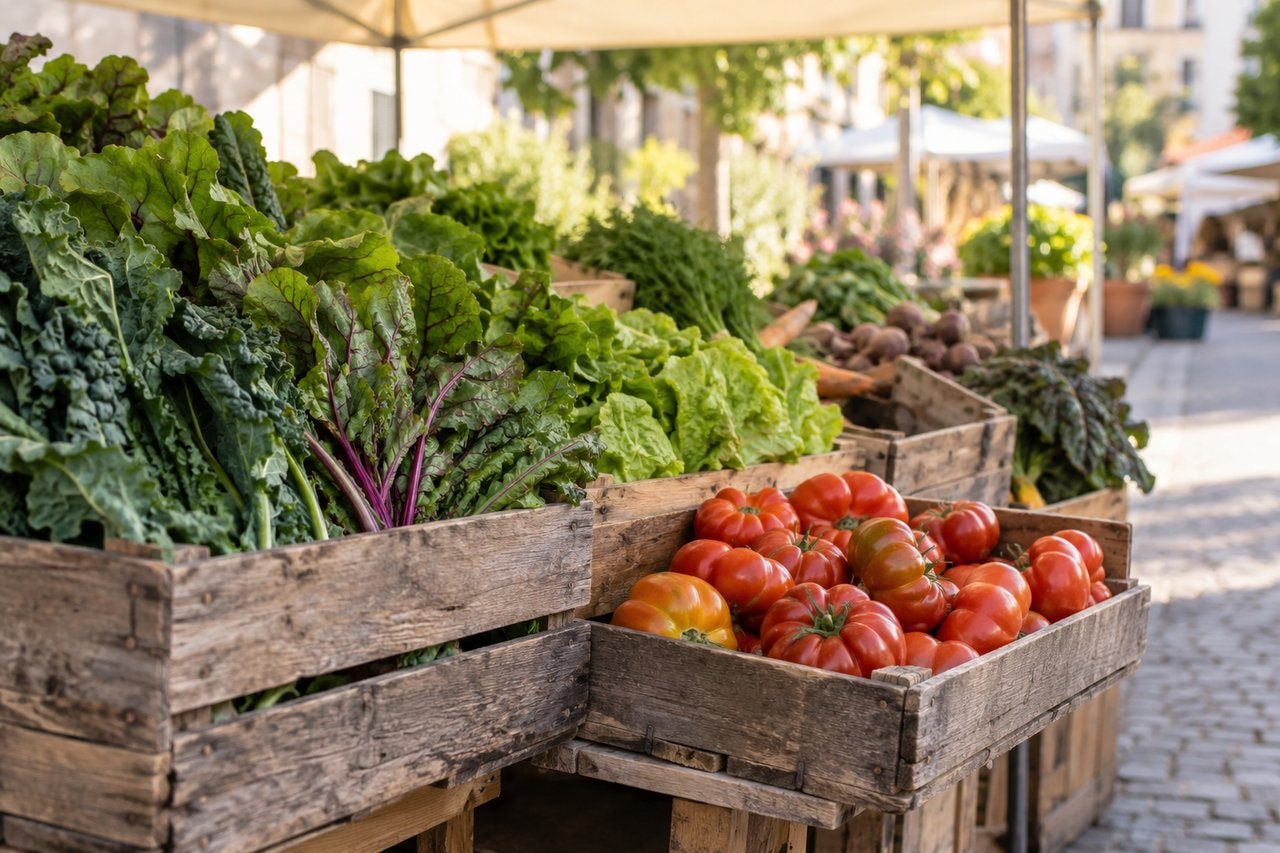
A farmers' market brings producers and customers together at a shared selling place. Wikipedia's farmers' market article describes direct sales by farmers from tables, booths or stands, indoors or outdoors. It distinguishes this arrangement from a public market with a wider mix of vendors. For an adult reader, the selling structure is only part of the picture. Food benefits, incentive arrangements, the source of products and the evidence about outcomes are related but separate subjects.
A national directory and a local-food category
USDA's Agricultural Marketing Service maintains the National Farmers Market Directory, with listings that include products and accepted forms of payment. Its description includes a recurrent common selling location and direct sales from farm vendors. The directory is an information resource, rather than a statement that every listed market operates the same way. Its existence does not establish the products, staffing or benefit arrangements of a particular place.
USDA's Economic Research Service frames local foods as a research subject involving alternative definitions, market size, producer and consumer characteristics, and possible economic and health effects. Local therefore does not, on its own, establish a single distance threshold, farming method or measured benefit. A farmers' market is a sales channel; local describes a relationship that needs its own definition. Community supported agriculture uses another form of producer-consumer arrangement.
SNAP at the market
USDA's Food and Nutrition Administration distinguishes SNAP-authorized markets and SNAP-eligible vendors in its guidance for market managers. It describes signs pointing cardholders toward an information booth and posters identifying vendors that accept the benefit. These details distinguish a place where produce is sold from a market with a stated SNAP arrangement. They do not mean that every market or stall accepts the benefit.
The same agency page describes matching incentives distributed as tokens or paper coupons for fruit and vegetable purchases. It also says an incentive project must be reported to the agency for compliance with equal-treatment rules. This is the agency's description of a program arrangement, rather than legal instructions or a promise of a particular incentive. The base food benefit and an additional incentive are different components. The broader meanings of access and affordability are considered on the food access in cities page.
Benefits for older adults
The agency's Senior Farmers Market Nutrition Program page describes a program intended to give older adults with low incomes access to locally grown fruits, vegetables, honey and herbs. It names farmers' markets, roadside stands and community supported agricultural programs among the channels it supports. The page also describes federal grants and administration by state agencies. That explains the program's structure without finding that an individual reader is eligible or that a particular market participates.
The setting does not erase the distinctions between benefits. SNAP, the senior market program and an incentive project have different purposes and administration. They can be discussed together because each concerns food transactions, but the presence of a market does not establish that any or all are available there. The adult and older-adult programs page places market benefits alongside meal services, food packages and general information resources.
Incentives and their evaluation
USDA's National Institute of Food and Agriculture describes the Gus Schumacher Nutrition Incentive Program as including funding and evaluation of projects intended to increase fruit and vegetable purchases by SNAP participants. The nutrition incentive component is a funding category with an evaluation purpose. Naming it does not establish that a market received a grant. An agency's purpose statement also differs from a measured result for participants.
A 2020 scoping review in Nutrients examined incentive programs for verified SNAP participants using quasi-experimental studies. It compared recruitment and eligibility, delivery and timing, eligible foods and retail settings. Most included studies took place at farmers' markets, and most reported positive effects on purchase or consumption of fruits and vegetables. The authors presented the findings as information for future design and evaluation. The varying structures and study-design scope are essential to reading those findings; the review does not describe a uniform incentive delivered everywhere.
Youth stands and the limits of outcomes claims
A youth-run stand raises questions about market participation and learning. The school produce stands page discusses social entrepreneurship, school-day food-sale rules and produce handling. A youth market's educational description remains separate from the source of its products, its benefit arrangements and evidence that it achieves a stated goal. Its setting alone does not establish how young workers are employed or supervised. The youth jobs and leadership page discusses that distinction for adult organizers.
A 2010 review in the Journal of the American Dietetic Association examined adult nutrition-related outcomes in farmers' market programs and community gardens. It excluded garden-based youth programs and found few well-designed studies using valid, reliable dietary assessment methods. The authors called for more evaluation, including stronger design. That finding explains why the existence of a market, enthusiasm about it and its federal benefit arrangements remain distinct from claims about changes in intake. Research asks what was measured; program descriptions explain how activities are organized.