Neighborhood food
Food access in cities: food security, food deserts and food justice
At a glance
- Food security concerns dependable access
- Household conditions differ from hunger
- Geographic access measures have limits
- Federal programs have different purposes
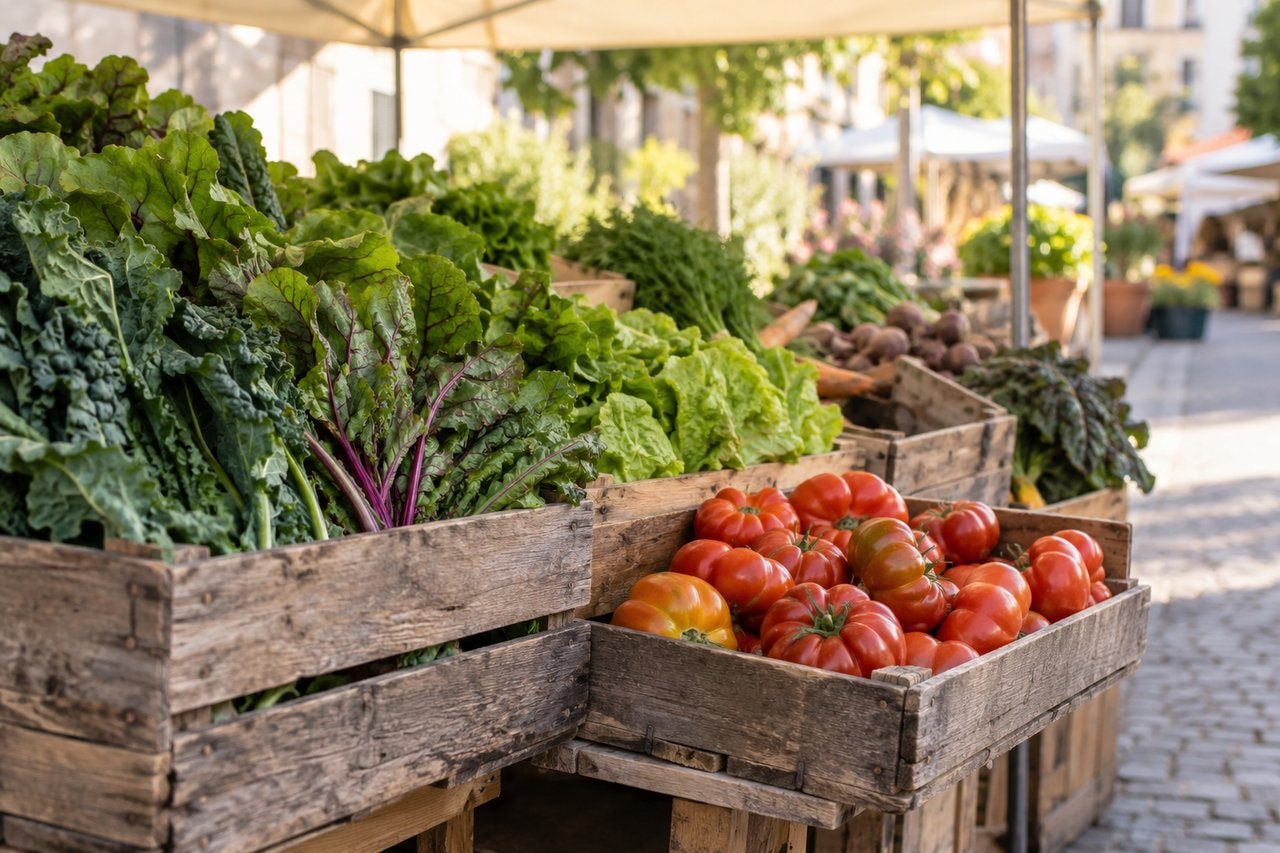
Food access in a city involves more than whether a shop exists nearby. It also concerns the resources needed to obtain food and whether that access remains dependable. USDA's Economic Research Service distinguishes a household's economic and social food-access condition from an individual's experience of hunger in its definitions of food security. This distinction is useful for adults reading about neighborhood food programs: a description of a household condition, a map of stores and a proposal for changing a food system answer different questions.
The official ranges of food security
ERS describes high food security as having no reported food-access limitations. Marginal food security involves indications of concern about sufficiency or a shortage in the household, with little evidence of changed food intake. Low food security concerns reduced quality, variety or desirability of food, generally without a reduction in the amount eaten. Very low food security involves disrupted eating patterns and reduced intake. These categories describe reported conditions; they are not judgments about a household's effort or character.
The distinction from hunger is also precise. ERS describes food insecurity as limited or uncertain access to adequate food at household level, while hunger is an individual physiological condition that may follow from food insecurity. A food-security survey therefore does not directly measure every person's physical experience. Keeping those concepts separate helps a reader understand why a household statistic should not be rewritten as a count of people experiencing hunger.
For 2024, Wikipedia's article on food insecurity in the United States reports that 13.7 percent of U.S. households, about 18.3 million, experienced food insecurity at some point during the year. This is a household-level annual prevalence statement. The same article describes food insecurity among employed households as well as other households. Employment status alone is therefore not an adequate description of the condition. The national estimate also does not establish a figure for a particular neighborhood or school.
Access, availability and continuity
Wikipedia's food security article describes availability, access, utilization and stability as dimensions of the concept, with agency and sustainability also considered. These terms distinguish a food supply from the ability to obtain and use it consistently. A city may contain places selling food while individual households face barriers to obtaining it. A program description that names a distribution outlet does not, by itself, measure all those dimensions. Markets and food benefits concerns some of the transaction arrangements within that broader picture.
What a food-desert measure describes
Wikipedia's food desert article describes limited access to affordable fresh food and explains that definitions vary. Measures can include distance from supermarkets, income, transportation and the kinds of food available. The article describes research using store directories, census information, interviews and surveys. It also notes that supermarket availability is used as a proxy because examining every store's products and prices is costly. A proxy is an indirect measure; it does not describe every household's route to food.
The article also describes debate about the term, including arguments that it obscures structural influences on access. Those are positions reported by the reference, rather than a position adopted here. The practical reading distinction is between a defined geographic measure and the wider circumstances it may leave out. Wikipedia's convenience store article describes small stores carrying groceries and other everyday goods, including the corner-store category. Naming a store type alone does not establish its products, prices or role in a neighborhood.
Community food security and related positions
Wikipedia's community food security article describes a place-based framework involving social, economic and institutional relationships that affect local food availability and access. It includes affordability, environmental sustainability and social fairness. This is a community-scale concept rather than a replacement label for the household categories used by ERS. Urban farms are one subject within discussion of local production, without establishing that growing food resolves every access barrier.
Wikipedia describes the food justice movement as a grassroots response to unequal access, with arguments concerning land, wages, working conditions and culturally appropriate food. Its food sovereignty article describes a position emphasizing people's control over production, distribution and consumption. Food security concerns access; sovereignty concerns control over the system as well. These movement positions are presented as the references describe them, without endorsing a political account or assigning blame.
Federal responses have different functions
USDA's Food and Nutrition Administration describes SNAP as food benefits that add to grocery budgets for families with low incomes. Wikipedia describes WIC, the Special Supplemental Nutrition Program for Women, Infants, and Children, as federal assistance for specified maternal and early-childhood groups. These descriptions identify program purposes and audiences; they are not eligibility findings for individual readers.
USDA's National Institute of Food and Agriculture describes the nutrition incentive component of GusNIP as funding and evaluation of projects for SNAP participants' fruit and vegetable purchases. A 2020 scoping review in Nutrients examined quasi-experimental studies of such incentives and reported positive purchase or consumption findings in most included studies. It also compared varying program structures. That bounded evidence concerns incentive designs, rather than a promise that every access program produces the same outcome. SNAP-Ed is considered separately as education.