Neighborhood food
Urban farms: growing food on city land
At a glance
- Urban agriculture includes food distribution
- Shared plots vary in management
- Growing soil needs assessment
- Research associations differ from causes
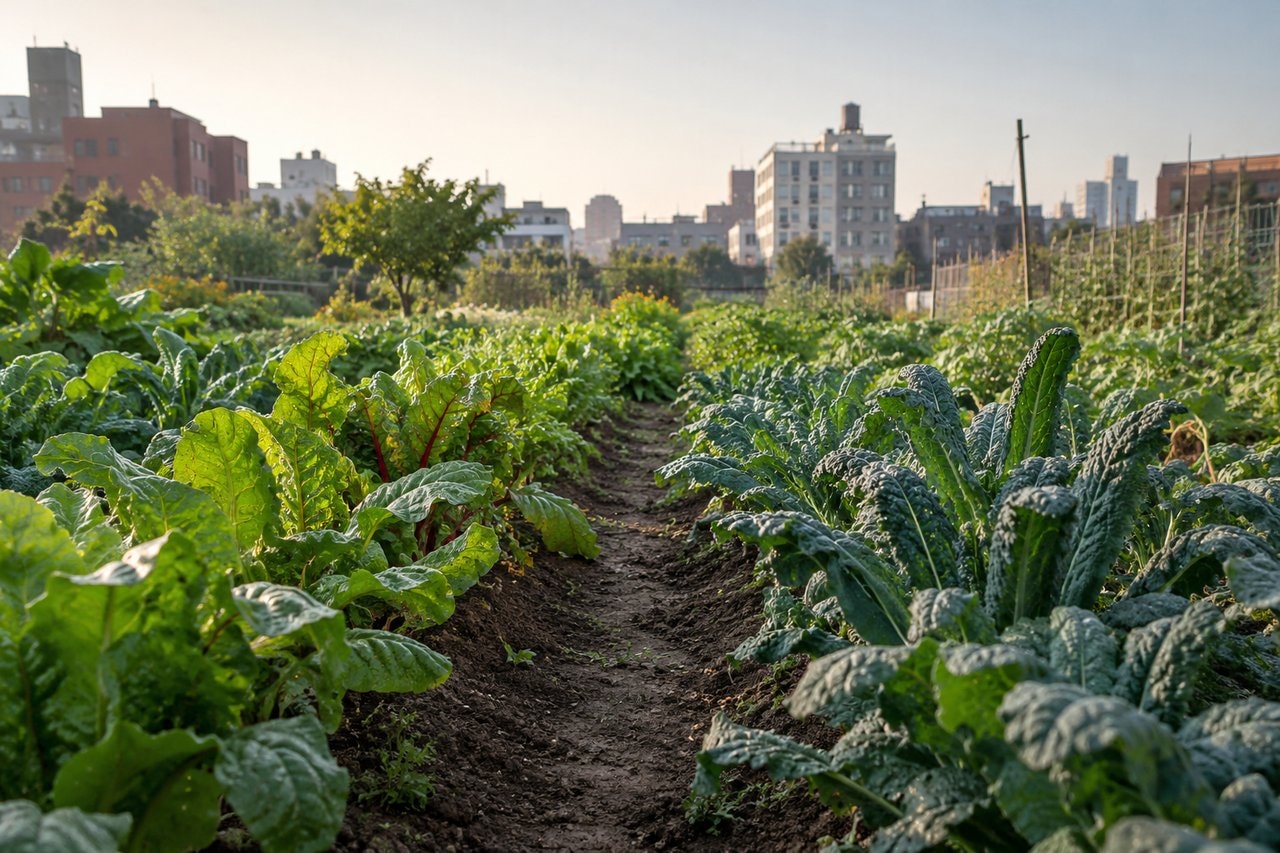
Urban agriculture names a location and a range of activities rather than a single model of ownership or distribution. Wikipedia's urban agriculture article includes growing, processing and distributing food in cities, and distinguishes agriculture on the rural edges of urban areas. It lists food access, income generation and social networks among motivations, while identifying contaminated soil as a concern. These descriptions establish the range of the subject; they do not show that every city farm has the same aims, practices or outcomes.
Farms, shared plots and growing structures
Wikipedia's community gardening article describes land cultivated by a group, either in separate plots or collectively. In separate plots, gardeners manage their own growing areas and harvests. In a collective garden, the group cultivates the land and shares the harvest. The terms describe management and participation. Urban agriculture is the broader location-based category. A community garden can fall within it without being identical to every operation described as an urban farm.
The same urban agriculture reference lists recreation, economic activity and landscape-related purposes alongside growing and distribution. These are reported purposes and potential benefits, rather than measured results for a particular site. Food access in cities explains why a growing site and a household's ability to obtain food are related but different subjects. Land, production, distribution and access cannot be treated as interchangeable measures.
Wikipedia's greenhouse article describes a structure intended to regulate temperature and humidity for growing plants. Transparent covering admits sunlight and limits heat loss, creating sheltered growing conditions. Its orchard article describes intentional plantings of trees or shrubs maintained for food production. A greenhouse concerns a growing environment, while an orchard concerns a planting type. Neither term establishes the ownership, business model or teaching arrangements of the land where it is situated.
Compost and the growing soil
Wikipedia's compost article describes material made through decomposition of organic inputs and used to alter soil properties and supply plant nutrients. The U.S. Environmental Protection Agency's home-composting guidance distinguishes carbon-rich and nitrogen-rich inputs, air and moisture. It includes food scraps and yard material among suitable inputs, while excluding pet waste, treated wood and diseased plants from a backyard pile. These are material-handling distinctions, rather than a recipe for food.
The EPA distinguishes the active decomposition process from finished compost, which it describes as a stable soil amendment. That distinction helps an adult reader understand why storing scraps and using finished compost are different tasks. A growing area's soil condition also remains separate from whether compost is present. School gardens discusses raised beds and garden-based lessons alongside these soil questions.
Testing soil for lead
Penn State Extension's residential soil guidance identifies past paint, vehicle emissions and industrial activities as sources of lead. It describes testing as the most reliable way to identify contamination and inform decisions about reducing exposure. Its guidance includes separate sampling of different areas, a map of sample locations and following the laboratory's collection instructions. The extension source also describes portable screening while emphasizing the importance of laboratory confirmation when results are uncertain.
The EPA's lead-exposure guidance describes using clean soil in raised beds or containers where lead levels are higher. It also discusses covering bare contaminated soil, washing after soil contact and keeping dirt from being tracked indoors. These practical measures are attributed to the agency. They address contact and movement of soil; the presence of a raised bed by itself is not a laboratory finding about the soil beneath or inside it.
The produce safety rule and its scope
The Food and Drug Administration's Produce Safety rule page describes minimum standards for growing, harvesting, packing and holding produce for human consumption. The FDA also describes exclusions and exemptions, including produce used for personal or on-farm consumption, specified crops rarely consumed raw and certain small farms. It describes a qualified exemption based on sales and end-user conditions, with modified requirements and continuing documentation duties. These categories concern the rule's scope; they do not determine an individual farm's status here.
What research can establish
A 2008 paper in the Journal of Nutrition Education and Behavior analyzed a cross-sectional survey conducted in 2003 to examine household community-garden participation and fruit and vegetable intake among urban adults. It reported an association with higher intake after statistical adjustment. This was an observational design, rather than an experiment assigning households to garden. The association is the reported finding; it does not establish that participation caused the difference.
A 2010 review in the Journal of the American Dietetic Association examined adult nutrition outcomes in farmers' market programs and community gardens. It found few well-designed studies with reliable dietary assessments and called for stronger evaluation. Farmers' markets discusses distribution and benefit arrangements separately from those outcome claims. Wikipedia describes Bartram's Garden as a historic public garden in southwest Philadelphia, and the garden's farm page describes a community crop farm there worked by paid high-school interns, neighbors and volunteers.